
What stirred even more murmurs were accounts that the press pool had been instructed to wait nearly twenty minutes before the official photo was released.
The delay was unusual enough to spark questions about what unfolded in the room before reporters were finally allowed inside.
One staffer quietly remarked that the president looked “noticeably drained” well before the photographer snapped the image—but that note mysteriously vanished from internal logs only a few hours later.
For years, Donald Trump has built his political message around a single defining idea: stamina as strength. He has mocked Biden as a leader drifting through events half-asleep,
touted his own need for little rest, and pointed to his late-night rallies as proof that he possessed more energy than anyone on the stage. It’s that carefully crafted image that makes the Cabinet-room photograph land with such weight.
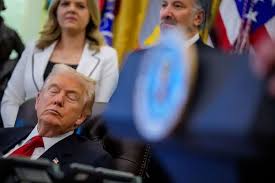
In that still frame, he is not the relentless showman he so often portrays. Instead, he appears as what he undeniably is—an aging man of 79 enduring a grueling two-hour briefing under harsh overhead lights, with advisers, cameras, and political opponents studying every twitch and blink.
Reactions to the image have split along predictable lines. His supporters argue it captures nothing more than a brief pause, a momentary eye-rest before he launched into what they praised as an “exceptional closing statement.” His critics see something very different: a leader whose schedule has shortened, whose travel has slowed, and whose fatigue is beginning to seep publicly into the performance he once dominated with ease.
Yet beneath all the commentary—mocking or sympathetic—sits a truth no partisan framing can erase: even the most powerful office in the world cannot outrun the realities of age.
🔹 Conclusion
As arguments swirl across social media and in newsroom panels, the debate moves beyond a single photograph with closed eyes. It becomes a reflection on how leadership changes when the leaders themselves grow older. Trump’s camp will continue projecting vigor; detractors will continue questioning it; and Americans will interpret the moment according to their own expectations and fears. But the image leaves behind a simple, unignorable reminder: power can influence nations, but time always influences the people who hold it.