
Most drivers believe they know the road inside-out — until a single sign exposes the cracks in their confidence.
It often appears after open stretches of tarmac, silently inviting a shift in driving behavior. Yet for something so familiar, it has sparked an unexpected wave of confusion.
The debate exploded recently when UK motorists collectively admitted that one of the simplest signs on the road is also one of the most misunderstood, proving that visibility doesn’t always equal clarity.
A recent viral conversation across UK forums has reignited interest in a highway sign that countless drivers admit they no longer fully understand, despite seeing it routinely.
The sign — a white circular marker crossed by a thick black slanted line — is formally included in the nation’s driving theory examination, but many motorists confess that its definition slipped their memory soon after passing. The debate began when one driver boldly claimed that “almost every driver” struggled to pinpoint its real purpose, triggering hundreds of responses from confused, amused, and sometimes concerned road users. The exchange shed light on how easily even widely taught traffic rules can blur once drivers fall into everyday routines rather than actively recalling what they learned.
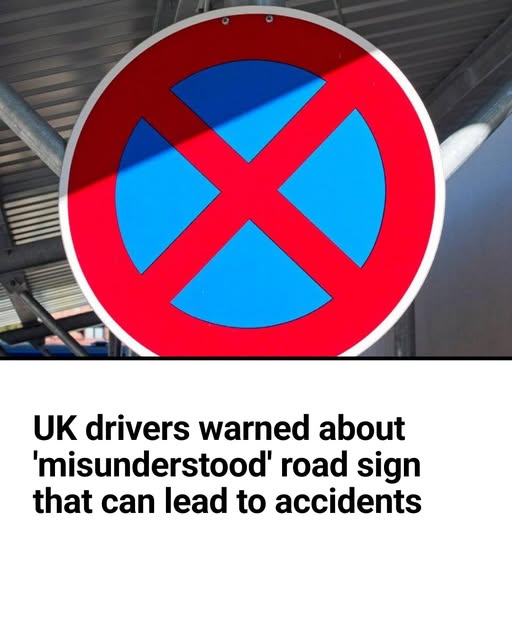
The sign signals the start of the national speed limit, yet its minimalistic appearance frequently causes misunderstandings. In the same Reddit discussion, commenters humorously proposed explanations like “UK slide challenge zone” or “unlimited speed permission,” laughing at how dramatically its interpretation can vary from person to person.
However, several drivers raised legitimate safety alarms, revealing that some individuals mistake it as a cue to accelerate instantly, merge aggressively, or begin overtaking without proper checks. The thread underlined a noticeable disconnect between structured lessons and real-world execution. Even beneath the jokes, the core takeaway was clear: many drivers are uncertain about how to put the sign’s instruction into practice without taking dangerous liberties.
As outlined by the RAC, this sign means that earlier enforced speed caps are no longer active, and drivers should now obey the national standard speed ceiling based on the road category ahead. Still, the rule is not universal in every scenario. On single carriageway roads, the speed limit for cars stands at 60 mph, while on dual carriageways and motorways, it increases to 70 mph.
Certain vehicle types, including larger vans or motors pulling trailers, are legally bound to reduced limits — 50 mph on single carriageways and 60 mph on dual carriageways. Meanwhile, urban zones lined with street lamps maintain the usual 30 mph rule unless a different figure is clearly posted. Because of this, recognizing the sign is only step one — understanding the new terrain and its limit variations is equally vital.
Even with official explanations available, road authorities repeatedly remind drivers that speed limits are boundaries, not benchmarks to hit. Rain, fog, road damage, pedestrian activity, blind bends, and vehicle congestion may all demand dramatically reduced speeds to maintain safety.
The RAC strongly advises motorists to lean on awareness, restraint, and situational assessment rather than using maximum speed allowances as default settings. The widespread uncertainty around this sign has opened the door to a broader discussion around the state of driver learning culture in the UK.
Many safety specialists maintain that passing a driving test should not mark the end of road knowledge. Regular information renewal, staying current with traffic law updates, and exercising sound decision-making are all essential elements of long-term driving skill and public safety.
By correctly interpreting the national speed limit sign — and combining that knowledge with caution, patience, and roadway awareness — drivers can contribute to safer journeys, smoother traffic behavior, and fewer avoidable accidents.
Conclusion
Understanding traffic symbols requires more than memorizing definitions — it demands applying them thoughtfully. The recurring confusion surrounding this particular sign reveals a deeper problem: many drivers no longer connect their theoretical knowledge with active road decision-making. Road safety leaders stress that limits must always be shaped around current conditions rather than treated as automatic green lights to drive faster.
Continuous learning and occasional refreshers, experts argue, should be embraced as part of responsible vehicle ownership. When motorists interpret signs accurately and adjust speed with care instead of convenience, they not only stay compliant with the law but also safeguard lives. Clear knowledge paired with real-world judgment remains the strongest tool for protecting everyone on the road.