
From the moment I parked outside Jacob’s new school that morning, a chill ran down my spine.
The building loomed larger than I remembered from the open house, its windows catching the sunlight at angles that made the glass almost blinding. The doors were closed, still, and the usual hum of students was muted, as though the school itself were holding its breath.
Somewhere behind a curtain, I thought I saw movement, a flicker of shadow. My heart skipped. I had come to ensure my son’s safety, to help him navigate a new environment—but a creeping suspicion whispered that I might be walking straight into someone else’s trap.
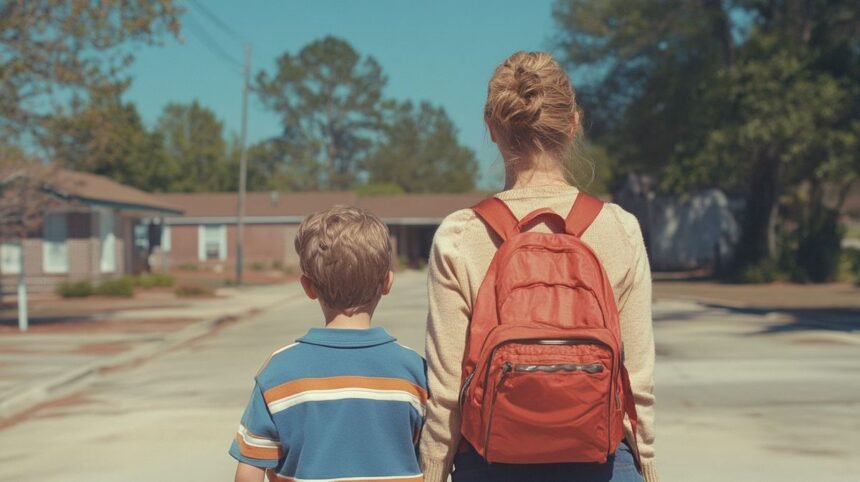
Jacob was standing near the front doors, his backpack dangling off one shoulder, his small frame hunched against the weight of the unknown. His teacher, Ms. Emily, a sharply dressed woman in a crisp blue blouse with her clipboard tucked under her arm, waited beside him. She offered a practiced smile—one of those smiles that doesn’t quite reach the eyes.
“Jacob had some challenges today,” she began. The words themselves would have been innocuous if they weren’t delivered with a subtle tightness, a hint of something I couldn’t quite name.
He didn’t meet my eyes as he climbed into the car. “Fine, I guess,” he murmured. His voice was low, tentative. Too small for an eight-year-old boy who used to fill a room with laughter.
Ms. Emily motioned for me to step aside. “Could we have a quick word?” she asked.
My stomach knotted as I followed her a few feet away from the car. The clicks of her heels on the pavement echoed in my ears.
“Jacob struggled with lessons,” she said, voice steady but emotionless. “There were conflicts with other students. He may not be a good fit here.”
My throat tightened. “Conflicts?” I repeated, incredulous. “Jacob? He’s shy, gentle… he’s never had trouble before.”
“We need to be honest,” she said evenly, almost rehearsed. “He might not thrive here.”
I felt a flash of anger—but I forced myself to stay calm. “Please,” I whispered. “Give him time. One day doesn’t define him. He’s smart, he’s kind, he’s resilient.”
She nodded politely, then walked away. I watched her leave, a chill settling into my bones. Inside, my chest felt heavy, the weight of worry pressing down like a vice. Jacob turned toward me slowly, his small reflection mirrored in the car window, distant and ghostly.
“How was your day, really?” I asked softly, trying not to sound anxious.
“It was scary,” he whispered. “No one talked to me, Mom. I just… I miss my old friends. Can we go back?”
My heart broke in two. I reached out and squeezed his hand. “I wish we could, sweetheart. But this new school, this move… it’s important. It means I can take better care of us. We’ll get through this together.”
He said nothing, staring silently at the road. I gripped the steering wheel, trying to steady my thoughts. The quiet between us was heavy, but I knew it was just the beginning of the battle we would face.
The next morning, I dropped him off again, offering soft encouragement and a smile. He held his lunchbox tight, nodding, silent. I hoped the day would go better.
Later, while showing a beautiful two-story home to clients, my phone buzzed sharply. It was Ms. Emily.
“There’s been a serious incident with Jacob. Come to the school immediately,” she said, her clipped tone igniting panic in my chest.
I excused myself from my clients, my thoughts racing. Grabbing the keys, I drove through quiet streets, heart hammering, imagining the worst.
Pulling into the school lot, I froze as I saw Mark, Jacob’s father, standing near the entrance. My stomach twisted. “Mark?” I whispered, more to myself than to him.
“I’m dating someone here,” he said, awkwardly. My blood ran cold. The pieces clicked together—Jacob’s troubles, Ms. Emily’s tone, Mark’s presence.
Inside the halls, the usual chatter was absent, replaced by a faint echo of shoes against linoleum and the sharp antiseptic scent that always lingered in schools. Approaching the principal’s office, a kind-eyed janitor stepped out.
“Mrs. Bennett,” he whispered, leaning close. “I shouldn’t be telling you this, but… they’re lying. Jacob didn’t do anything. Ms. Emily set him up.”
My chest tightened as I pushed open the office door. Jacob sat stiffly in a chair, legs swinging nervously, pale and silent. The principal’s words struck like a hammer:
“Your son forged his test answers. This is serious. Suspension is being considered.”
“What?” My voice cracked.
Jacob’s eyes widened, filled with fear. “Mom, she told me to do it! She gave me the pencil!”
I whirled toward Ms. Emily. “Don’t speak to my son like that,” I said, voice shaking but controlled.
Then it clicked. Emily. His teacher. The woman dating Mark. This wasn’t about school. This was personal.
“I believe Ms. Emily tried to push my son out because of her relationship with you,” I said, voice steady despite the rush of adrenaline.
Mark’s eyes widened, disbelief mingling with horror. “Emily… is that true?”
Her face flushed red. “Yes. Susan, you can’t just take Mark from me.”
“Take you back? You were never mine to take,” Mark shot back. “And how dare you involve our child in this?”
The principal cleared his throat. “Ms. Emily, this is completely inappropriate. You are dismissed immediately.”
I knelt beside Jacob, wrapping him in a tight embrace. “I’m so sorry, sweetheart.”
“It’s okay,” he whispered against me. “I’m glad you know the truth.”
Hand in hand, we walked out into the warm sunlight. For the first time that day, I felt a flicker of relief. Jacob squeezed my hand, and I squeezed back. Somehow, I knew we would be all right.
The drive home was quiet but comforting. I glanced at Jacob, noticing his small face slowly relax, a glimmer of trust returning. It had been terrifying, heartbreaking, and confusing—but together, we had navigated it.
That evening, I tucked him into bed, tracing a finger along his hairline. “You’re safe now,” I whispered. “And no one can take that away.”
Jacob nodded, sleep tugging at his eyes. “Thanks, Mom,” he murmured.
In the days that followed, the school took swift action to remove Ms. Emily from her teaching position entirely.
Staff meetings reinforced the importance of separating personal matters from professional duties. And Mark… he began to understand the gravity of what had transpired, his carelessness nearly putting his child in harm’s way.
Through it all, I learned something profound: vigilance isn’t about paranoia—it’s about love. Listening to my child, trusting my instincts, and standing firm when something feels wrong are acts of protection, of devotion.
Jacob’s safety, his sense of trust, and his well-being were more important than appearances, explanations, or anyone else’s convenience. And as I watched him play in the backyard that weekend, laughing and unburdened, I realized: together, we had faced the world—and we had won.
Conclusion
This wasn’t just a story about school or a deceitful teacher. It was about a mother’s intuition, a child’s vulnerability, and the unbreakable bond that guides us through uncertainty. By trusting myself, standing up for Jacob, and confronting the toxic influence directly, we safeguarded what mattered most.
The lesson is clear: love demands vigilance, courage, and unwavering presence. And in protecting Jacob, I found a deeper understanding of strength, resilience, and hope.